
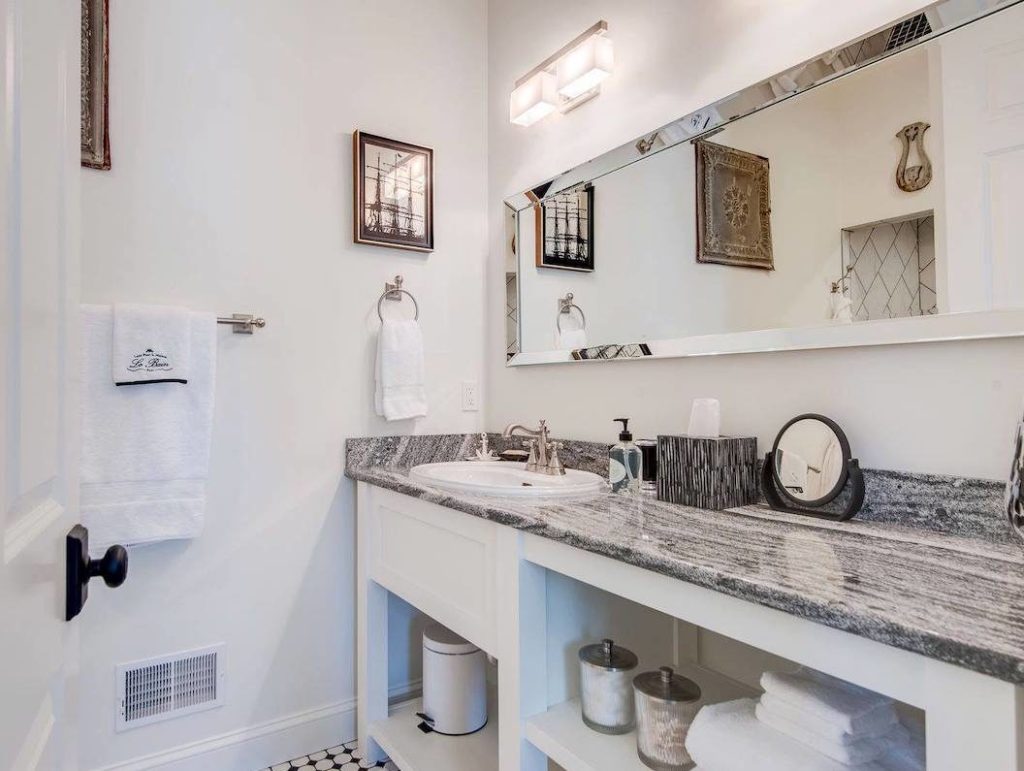
Choosing a countertop for the kitchen is one decision. Choosing one for the bathroom countertop is a different conversation entirely — smaller footprints, constant moisture, integrated sinks, and a buyer’s eye that lingers a little longer in a spa-like space. If you’re weighing options for a bathroom remodel, it helps to know the full range of materials on the market before narrowing down to what actually makes sense for daily use.
Why Bathroom Countertops Need a Different Standard Than Kitchens
Kitchens deal with knives, hot pans, and daily food prep. Bathrooms deal with something different: standing water around faucets, humidity, makeup and skincare products, and — in most homes — a much smaller vanity surface where every seam, edge, and finish detail is visible up close. A bathroom vanity countertop also tends to double as storage-adjacent real estate, so integrated sinks and clean transitions matter more here than almost anywhere else in the house. That combination of moisture exposure and tight visual scrutiny is exactly why the right material for a bathroom isn’t always the same one you’d pick for a kitchen island.
The Full Range of Bathroom Countertop Materials at a Glance
Homeowners researching bathroom countertop materials usually run into seven common options, each with a real trade-off worth knowing before you shop:
- Granite — a natural stone with a genuinely premium, one-of-a-kind look and strong heat resistance. The trade-offs: it’s porous enough to need periodic resealing, it’s heavy, and it runs toward the higher end of the price range.
- Marble — arguably the most elegant natural stone option, but also the most high-maintenance. It’s soft and porous relative to other stones, so it scratches and etches more easily and needs regular sealing to hold up in a wet room.
- Quartzite — a natural stone that reads as luxurious as marble but performs closer to granite in hardness. It’s a strong choice for a high-end primary bathroom, though it typically carries a premium price tag and still benefits from sealing.
- Cultured marble — a manufactured surface (resin plus marble dust) that’s genuinely budget-friendly and easy to clean, and can be molded into a one-piece integrated sink. The catch: it scratches more easily than engineered surfaces and has a shorter realistic lifespan.
- Laminate — the least expensive option by a wide margin, but water exposure over years typically causes swelling or delamination at seams, which makes it a weaker long-term fit for a room defined by moisture.
- Quartz — an engineered surface made from crushed natural quartz bound with resin, giving a dense, non-porous surface that resists scratching and staining with no sealing required.
- Solid surface — a fully synthetic, thermoformed surface (the category Corian solid surface is best known for) that can be shaped and seamed with no visible joints, including one-piece integrated sinks.
Every one of these can technically go in a bathroom. The question worth asking isn’t just “what looks best,” but “what still looks and performs the same way in five years of daily moisture exposure.”
Why Quartz and Solid Surface Are the Practical Choice for Most Bathrooms
Weighed against that five-year question, Cambria quartz and Corian solid surface come out ahead for most households, for a fairly simple reason: both are non-porous and require no sealing, while granite, marble, and quartzite all need periodic resealing to keep moisture and staining at bay — an easy maintenance step to skip in a bathroom that gets used every single day. Compared with laminate and cultured marble, quartz and solid surface also hold up meaningfully longer against the exact conditions a bathroom produces: standing water, soap residue, and constant humidity.
That doesn’t make natural stone or budget laminate the “wrong” choice — a quartzite vanity in a primary suite bathroom can be a genuinely striking design statement, and cultured marble is a reasonable call for a rental property or guest bath where budget matters more than longevity. But for the bathroom most homeowners are actually renovating — a primary or family bathroom that needs to look good and perform well for a decade or more without a resealing routine — quartz and solid surface are where the durability, low maintenance, and design flexibility line up most consistently. We’ve covered how the two compare to each other in more depth in our quartz vs. solid surface countertops comparison, and in why solid surface countertops are a smart choice for homeowners who haven’t considered it as a first option.
Seamless Design & Integrated Sinks: Where Solid Surface Wins
This is the category where bathrooms genuinely differ from kitchens, and it’s where solid surface has a clear structural advantage over quartz — and over every natural stone option. Because it’s thermoplastic, solid surface can be heated, shaped, and joined with color-matched seams that are effectively invisible, which means the sink and countertop can be fabricated as one continuous piece.
That matters more in a bathroom than almost anywhere else in the home, for a practical reason: the seam between a countertop and a drop-in or undermount sink is exactly where grime, soap residue, and standing moisture like to collect. An integrated sink eliminates that seam entirely. If your priority for a vanity is a clean, minimal look with nothing for water to pool against, solid surface is the material built for that job. Quartz, granite, and quartzite can all be paired with an undermount sink, but none of them achieve the same one-piece, seamless result.
Heat, Moisture & Everyday Wear
Bathrooms rarely deal with the kind of direct heat exposure a kitchen does, so the heat-resistance edge that granite and quartz hold over solid surface matters less here than it would over a stovetop. Quartz tolerates brief heat contact — from a curling iron or straightener set down carelessly — slightly better than solid surface, which is worth a moment’s thought if that’s a habit in your household.
Where quartz and solid surface are more evenly matched — and where both pull ahead of laminate and cultured marble — is day-to-day moisture resistance. Both are non-porous, so neither absorbs water, soap, or skincare products the way natural stone or laminate can. Both resist staining and are easy to wipe down. The practical difference between the two shows up less in daily performance and more in repair: solid surface can typically be sanded and re-polished if it’s scratched or scuffed, while a chip or crack in quartz usually calls for a professional repair. For a high-traffic family bathroom, that repairability is worth factoring in alongside the up-front finish.
What Bathroom Countertops Cost
Bathroom vanities are almost always smaller than kitchen countertops, which narrows the real-dollar gap between materials more than people expect. Granite and marble tend to sit at the higher end of the range, reflecting slab cost and the extra labor of sealing and periodic maintenance. Quartz countertop cost generally lands in a comparable middle tier, reflecting the material’s density and fabrication process, while solid surface is often priced a bit more moderately — though a fully integrated sink design adds fabrication time that can narrow that gap. Laminate and cultured marble sit at the budget end, which is exactly why they trade off lifespan for up-front savings. Because a bathroom vanity is a comparatively small project, this is one of the more approachable places in a home to invest in a premium surface without a kitchen-sized budget. Multi-bathroom projects — say, a primary suite and a hall bath done together — are also where fabricators can sometimes offer better per-square-foot pricing than tackling each vanity separately, so it’s worth asking about bundling if you’re updating more than one bathroom at once. A consultation with your fabricator is the fastest way to get an accurate number for your specific layout and material choice.
Does a New Bathroom Countertop Increase Resale Value?
Yes — an updated bathroom countertop is one of the more cost-effective ways to add resale value, because bathroom upgrades typically cost less than kitchen ones while still influencing buyer perception of the whole home.
Real estate industry analysis consistently ranks kitchen and primary bathroom updates among the home improvements most likely to pay off at resale, and countertops are a major part of what buyers notice first when they walk into either space. The reasoning holds across most of these materials: buyers respond to a clean, modern, low-maintenance surface far more than they respond to a specific material name. That said, resale value tends to favor quartz and natural stone over laminate or cultured marble, since buyers and inspectors alike read budget materials as a sign of a dated or corner-cut renovation. Within the premium tier, quartz’s natural-stone look in neutral tones reads as a broadly appealing, move-in-ready upgrade to the widest range of potential buyers, while solid surface still supports resale through its clean, seamless, updated feel — just a slightly more personal aesthetic choice than quartz’s more universally recognizable stone look.
If resale is a genuine priority, leaning toward a neutral quartz finish is the safer bet. If you’re renovating for your own long-term use and love the seamless, integrated look, solid surface delivers real value without sacrificing much on the resale side — and either one will outperform a laminate or cultured marble vanity when it’s time to sell.
Which Material Is Right for Your Bathroom?
There’s no universally “better” choice here — only a better fit for your budget, your bathroom’s use, and how long you plan to keep the surface looking new:
- Choose granite, marble, or quartzite if a one-of-a-kind natural-stone look is the top priority and you don’t mind a resealing routine.
- Choose laminate or cultured marble if budget is the deciding factor and the bathroom sees lighter use, such as a guest bath or rental property.
- Choose quartz if you want a stone-like, premium finish, strong scratch resistance, and the broadest buyer appeal for resale, with none of the sealing maintenance natural stone requires.
- Choose solid surface if a seamless, integrated-sink vanity with easy repairability is the priority, especially in a high-use family bathroom.
For most homeowners renovating a primary or family bathroom, that shakes out to quartz or solid surface as the practical everyday pick — and the best way to settle between the two for your specific vanity, sink style, and budget is to see and feel both materials side by side. If you’re ready to compare quartz and solid surface samples in person for your bathroom project, schedule a consultation with Blasius and we’ll help you land on the right material the first time.