
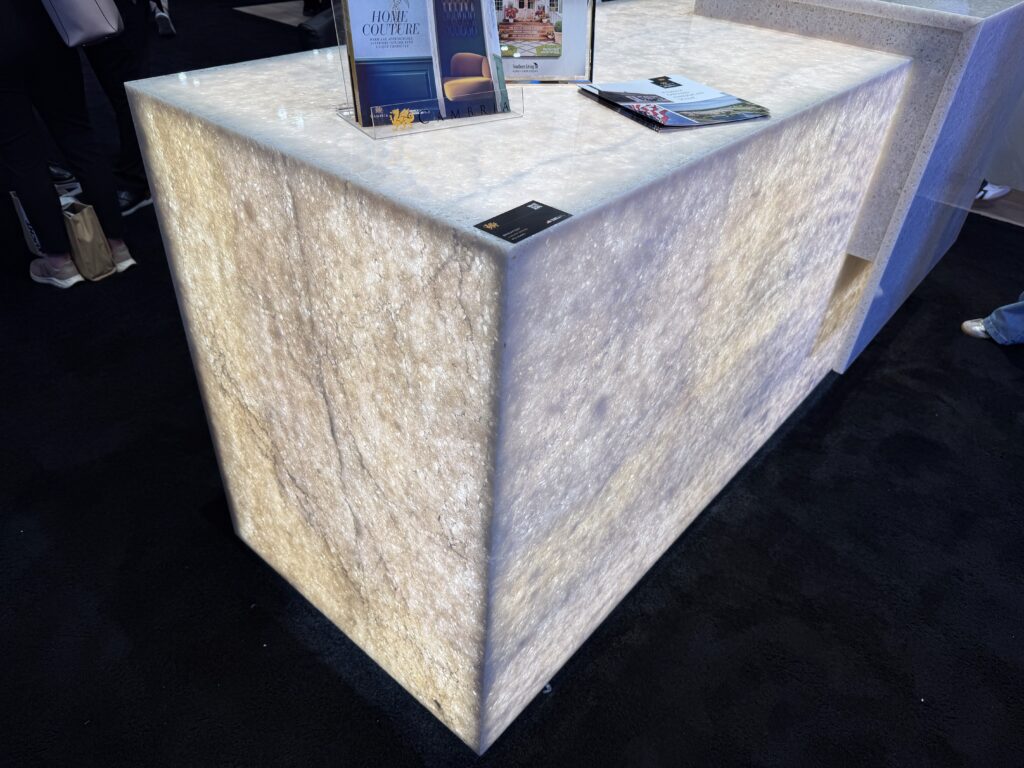
What Is Stone Backlighting & How Does It Work?
A lot of people ask us about the glowing effect they’ve seen in photos of high-end countertops and bathroom feature walls. It’s called stone backlighting, and it’s one of the more striking applications we can do with certain quartz designs. The technique uses LED light panels behind the stone to illuminate veining and create drama in ways that standard surface mounting can’t touch. But not every slab works for it, and the process involves more than just dropping a light behind the material.
Here’s how we do it at Blasius, using Cambria designs specifically engineered for this kind of installation.
How Backlit Countertops in West Bloomfield, MI Work
The principle is simple: certain quartz designs are translucent enough to let light pass through when you backlight them. In our showroom, we demonstrated this with a cell phone held up to a 3 centimeter slab of Cambria Brighton. You could see an orange glow right through the material where the phone’s light hit it. That much transmission means the stone can handle LED panels behind it without looking dull or muddy.
We don’t use cell phones in actual installations, of course. We use flat LED light panels that mount to the substrate before the stone goes up. These panels are low profile, energy efficient, and designed for even distribution across the entire piece. For designs like Brighton that have a relatively uniform translucency, you can light the whole slab and get a consistent glow across the surface.
The Machining Process for Veined Designs
Some designs, like Cambria’s Skara Brae, have veins that are more translucent than the background stone. In those cases, we don’t want the entire slab to glow; we only want light to come through the veining itself. That requires a more involved fabrication process.
First, we machine the veins on the backside of the slab. We thin them down in specific areas where we want light to pass through, essentially creating channels that let the LED light penetrate the stone along the natural vein pattern. Then we paint everything else on the back with black latex paint. The paint blocks light from bleeding through the background areas, so you only get illumination where the veins are.
This method gives you control over the effect. You decide where the light appears and where it doesn’t. The result is a glowing vein network that looks like the stone is lit from within, rather than a uniform backlit glow.
Managing Edges and Cutouts
One of the technical challenges with backlighting is managing light bleed around the edges and cutouts. If you don’t seal the perimeter correctly, light leaks out around outlet covers, the edges of the slab, and anywhere the stone meets another surface. It breaks the illusion and looks unfinished.
We address that by painting the edges and the back perimeter with the same black latex paint we use to mask non-vein areas. Around outlet covers, we carefully plan the cutouts so the light stays controlled and doesn’t spill out in unwanted directions. The goal is for the light to appear only where the stone itself is translucent, not around the hardware or seams.
Where Backlit Stone Makes Sense
We’ve installed backlit stone in a few settings where it really stands out. Bathroom feature walls behind freestanding tubs are a common application; the backlit veining adds a spa-like quality and becomes a focal point in the space. Kitchen islands and bar areas also work well, especially in contemporary designs where you want that dramatic glow to anchor the room.
It’s not something every homeowner needs or wants, but for the right design and the right space, it’s a striking way to use quartz. The effect is most visible in low-light conditions, so it works best in rooms where you can control the ambient lighting and let the backlighting take center stage.
How Do You Choose the Right Stone for Backlighting?
Not every quartz is suitable for backlighting. The material has to be translucent enough to let light pass through at the thickness you’re working with, which is typically 3 centimeters for quartz countertops. Cambria designs like Brighton and Skara Brae are engineered with this application in mind, so we know they’ll perform.
If you’re considering backlit stone for your project, bring it up early in the design phase. We’ll need to plan the substrate, the electrical for the LED panels, and the fabrication details on the back of the slab. It’s not something you can add after the fact; the installation has to be designed around the backlighting from the start.
Maintenance and Longevity
The LED panels we use are rated for tens of thousands of hours, so you’re not going to be replacing them anytime soon. The stone itself requires the same care as any other custom countertop installation in West Bloomfield, MI: wipe spills promptly, use mild soap and water for cleaning, and avoid harsh chemicals that could damage the surface. The backlighting doesn’t change the durability or maintenance requirements of the quartz.
If a panel does fail down the road, access depends on how the installation was designed. In most cases, the stone is mounted in a way that allows the panel to be serviced from behind without removing the slab. That’s another reason to work with a fabricator who understands the technical side of backlighting and plans for long-term serviceability.
Here’s the demonstration we filmed in our showroom, showing light transmission through Brighton and explaining the full process:
What to Expect From a Backlit Stone Project
Backlighting adds complexity and cost to a countertop project, but the result is unlike anything you can achieve with traditional installation methods. You’ll need to coordinate with your electrician for the LED panel wiring, and the fabrication timeline will be longer because of the machining and painting work on the back of the slab. But if you’re after a design feature that makes people stop and ask how it was done, this is one of the most effective options in quartz.
If you’re curious about backlit stone for your kitchen, bathroom, or bar area, let us know. We can show you the designs that work best for this application and walk you through what the installation process looks like. Reach out to book an appointment or request a consultation, and we’ll go over the options.